
An Ode to Damariscove
by Sammie Huss, BRLT Summer Intern
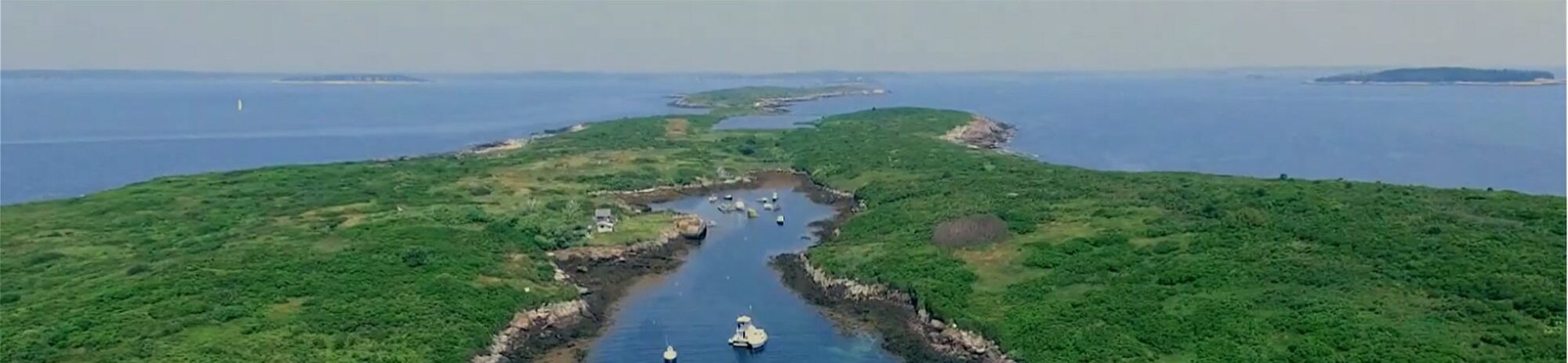
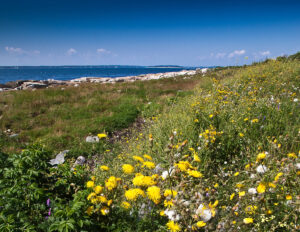
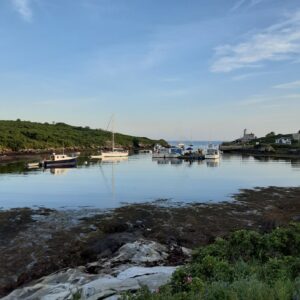 A salty sea breeze and a sun backed by summer’s strength enwrap Damariscove Island. Pulling up to the dock, we land alongside herring gulls and common terns, preparing, just as we are, for a busy season ahead. Whether you’re drawn by trails weaving through coastal tundra and alpine plants, fruitful tidal pools along rocky shore, a six-acre freshwater pond, wildflower and sea bird filled upland meadows, or experience-based learning in our island museum, Damariscove Island is a magical place for coastal summer exploration.
We encourage everyone to make the six-mile journey out to sea from Boothbay Harbor to explore all the island has to offer. This summer a few happy members of our staff have already had the chance to do just that. With our hands dirty and hair salty, we set to work prepping the trails, opening educational and practical facilities, and enjoying a bit of island time. A now freshly groomed trail network leads out to stunning viewpoints and a cobble beach. Our museum’s doors are open with plentiful information on the history of Damariscove Island. Lumber has been hauled up trails and repairs are in progress across the island. Marine debris has been removed from the coast, and Damariscove’s shores are cleared for landing.
Damariscove Island has been under the care of Boothbay Region Land Trust since the summer of 2005 when ownership was transferred to BRLT from The Nature Conservancy. Over the last 21 years, committed caretakers, volunteers, and staff have stewarded the land and ensured public access to the southern half of the island. This summer, we’ve had the chance to partner twice with Maine Island Trails Association (MITA), whose volunteers, in conjunction with BRLT staff, have been instrumental in getting the island ready for the season.
The history of Damariscove delves far beyond the 21 years of BRLT’s stewardship on the island. Prior to its colonization in 1614, the island was vital to the Abenaki people for fishing and berry picking. It served as one source in a larger trade network of communities connected by the Algonquin language as well as a seasonal vacation spot for families to camp, hunt, and fish.[i]
In the early 1600s, colonizers arrived in the area now known as Boothbay Harbor, establishing forts and settlements throughout the region. These settlements were erected forcefully, violently displacing the Abenaki people who had thrived in the region for centuries.[ii] Despite such historical displacement, Abenaki culture and communities still very much exist, located largely in Vermont, Maine, Massachusetts, and Quebec.[iii]
Following colonization of the area, Damariscove became the base for a permanent fishing community until the last resident left in 1930. The island was then acquired by The Nature Conservancy in 1966 and ownership was transferred in 2005 to the Boothbay Region Land Trust. For a deeper look into the history of the island, come walk among ruins embedded in the land. Explore our informative museum and read about the varied communities that found nourishment or homes on Damariscove. It is crucial to BRLT that the full breadth of history of the island is available and accessible to all of its visitors. From shellfish middens to structural ruins, there’s much to explore and learn from on Damariscove.
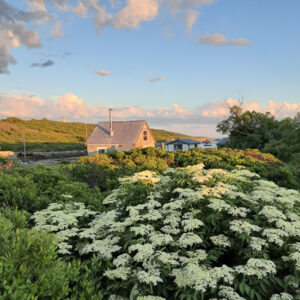 Today, hundreds of species are thriving on the island, where varying conditions and ecosystems make for a curious collection of life. There are double-crested cormorants diving through salt marsh, moss and lichen absorbing dense sea fog to nourish local plants, and black-crowned night herons dozing under thick brush in protected breeding grounds. This level of ecological diversity within a confined two-mile stretch makes Damarisove Island a true biological haven.
Our dedication to preserving this remarkable island is displayed most clearly within the island’s two seasonal caretakers. Aiko and Masa, who have been caretaking for six and four seasons respectively, are instrumental in the ecological success and accessibility of the island. They are active and excited to help answer questions during your visit. With daily trail maintenance, habitat restoration, and invasive species removal, the caretakers dedicate their summer to preserving Damariscove. In conversation with Aiko, I mentioned her clear commitment to Damariscove. Her response summed it up.
“How can you not feel passion for this place? You step foot [on the island] and you can feel its importance. It’s wonderful.”
At BRLT we are committed to ensuring the accessibility of the region’s preserves while also protecting their habitats and stewarding their lands. We’re thrilled to have Damariscove Island ready for the summer 2026 season. Make your way to the salty cobble shores and wave hello to the sea birds for us (and Aiko and Masa too).
[i] Strawbery Banke Museum. “Abenaki Heritage Initiative | Learn Abenaki Heritage – Explore Today — Strawbery Banke Museum,” n.d.
https://www.strawberybanke.org/abenaki-heritage-initiative.
[ii] “First Meetings: Unearthing the Beginnings of Abenaki-English Contact in Maine’s Boothbay (U.S. National Park Service),” n.d.
https://www.nps.gov/articles/000/first-meetings-unearthing-the-beginnings-of-abenaki-english-contact-in-maine-s-boothbay.htm.
[iii] Vermont History Explorer. “The Abenaki & the Europeans,” n.d.
https://vermonthistoryexplorer.org/the-abenaki-and-the-europeans.