

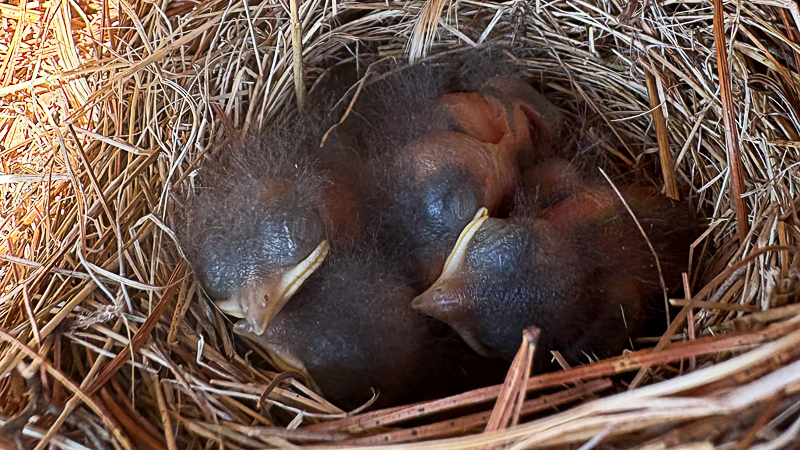

Volunteer and long-time birder, Stan Wakefield, shares regular updates and pictures on bird nesting activity at BRLT’s bird boxes monitored at Oak Point Farm, Singing Meadows, Lobster Cove Meadow, Penny Lake, and Zak preserves. Data is also reported to NestWatch, a citizen-science monitoring program developed by the Cornell Lab of Ornithology and used nationwide to track the status and trends in the reproductive biology of birds. We encourage readers to check back frequently from April-August to keep up on all of the changes throughout the season.
——————————————————————————————————————-
The Boothbay Region Land Trust has completed another year of monitoring 22 nest boxes on 6 different Land Trust preserves. The assistance of dedicated volunteers made it possible to keep up with all the activity we observed this breeding season. Carolyn, Evan, Tina, plus the team of Cheryl and Mark spent many hours conducting twice weekly inspections of nest boxes from April through July, and the BRLT is grateful for their commitment. All of the data collected from our observations were provided to Cornell University’s Lab of Ornithology NestWatch Program.
Compared to previous years, the breeding activity we observed this season was a mix of success and failure. We saw breeding activity by three bird species in our 22 nest boxes: Eastern Bluebirds, Tree Swallows, and Black-capped Chickadees. The number of young Bluebirds that fledged was down from previous seasons, while the number of fledging young Tree Swallows was somewhat higher. The number of young Chickadees released into the world was slightly higher than in previous years.
Autumn View Farm, the Land Trust’s newest preserve, has three nest boxes, all of which saw moderate success. Six Tree Swallows, three Bluebirds, and three Chickadees fledged from these nest boxes.
Lobster Cove Meadow, with two nest boxes, saw eight Bluebirds fledge and zero Tree Swallows. These numbers are lower than in previous years.
Oak Point Farm has five nest boxes, only four of which were used successfully this season. Five Bluebirds and fifteen Tree Swallows fledged from those four boxes. The number of fledging Bluebirds is significantly lower than in previous seasons.
Penny Lake, with three nest boxes, had an interesting mix of nesting efforts. Nine Tree Swallows, eight Chickadees, and three Bluebirds fledged at Penny Lake this season. Bluebird numbers were also lower this season at this preserve.
Singing Meadows, the largest of six preserves with nest boxes, had the greatest success with Bluebirds. Five nest boxes produced thirty- nine young Bluebirds this season, an all-time high. One nest box saw only a single young Tree Swallow fledge, an all-time low.
Finally, Zak Preserve had a very good season with fifteen Bluebirds, five Tree Swallows, and five Chickadees fledge successfully from three nest boxes.
Overall, the total number of Eastern Bluebirds that fledged successfully this year was seventy-three, lower than the mid-to-high nineties in previous seasons. Thirty young Tree Swallows fledged, a slightly higher number, and sixteen new Chickadees were introduced to the world. The lower number of Bluebirds this season can be attributed to a combination of loss of eggs and/or young to unknown predators and nest takeover by other species.
As summer continues to move along, so does the bird breeding season. All six Land Trust preserves with nest boxes are showing signs that the breeding season is winding down. Five preserves currently have only one active nest box, and one has two. While some nest boxes may become active with nesting activity, it’s likely to be with birds such as Black-capped Chickadees and Nuthatches.
The Eastern Bluebird season will come to an end when four active nests fledge their youngsters in the next couple of weeks at Singing Meadows, Lobster Cove, Penny Lake, and Zak.
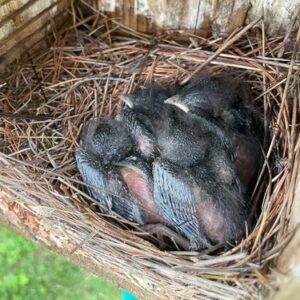
Baby Bluebirds
Black-capped Chickadees have recently taken up occupancy in vacated nest boxes at Oak Point, Penny Lake, and Autumn View.
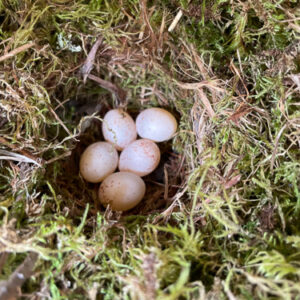
Chickadee Eggs
Once all the nest boxes on our preserves have been vacated, we’ll do a season wrap-up of the successes (and failures) of the Bluebirds, Tree Swallows, and Chickadees that nested in those boxes.
Of course, bird nesting activity continues on all Land Trust preserves with a variety of birds that don’t use nest boxes. The commonly seen & heard Song Sparrows are nesting in tall grasses and shrubs just about everywhere. American Goldfinches, often seen at our seed feeders, are late nesting birds that prefer to build their nest in shrubs. The abundant and frequently seen Dark-eyed Junco, which can be seen foraging for spilled seed on the ground, nests primarily on the ground, but might also use a small, flat structure on a building.
Other indirect signs of nesting activity can be seen at our seed and suet feeders in backyards. Watch for adult birds such as Downy and Hairy Woodpeckers gathering suet and taking it to their recently fledged young, who are often seen hanging out in nearby trees. Chipping Sparrows can be seen on the ground feeding their young with seeds gathered from feeders.
Once the young birds raised this season are on their own, many species, like Goldfinches, will begin to turn their attention to migrating south for the winter. Some species will depart earlier than others, while other, more hardy species, such as Chickadees and Titmice, will stay and tough out our Maine winter.
As a reminder, bluebirds will typically try to raise two broods per season, while Tree Swallows only nest once.
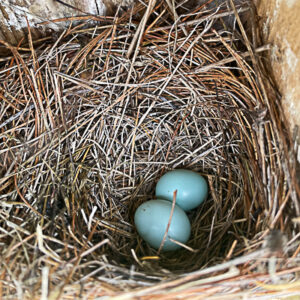
New Eastern Bluebird eggs at Penny Lake
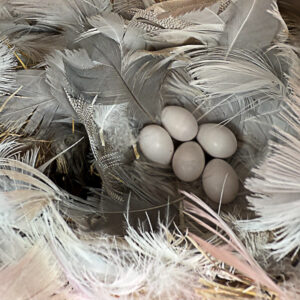
Tree Swallow eggs at Singing Meadows
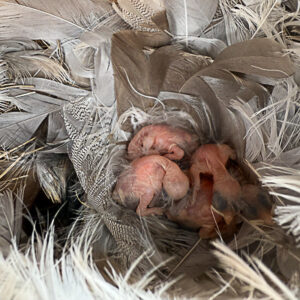
Recently hatched Tree Swallows at Zak
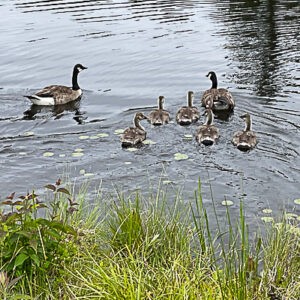
Growing young Canada Geese at Oak Point Farm
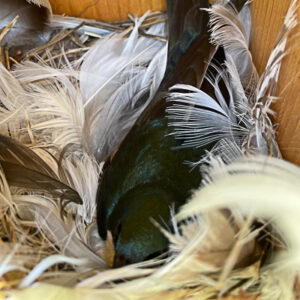
Tree Swallow incubating eggs at Autumn View Farm
Last week (Monday-Friday) saw a big drop in the number of migrating birds flying over Lincoln County compared to the previous week. The rainy and windy weather likely had a lot to do with it. With a noticeable improvement in weather over the weekend, the number of migrating birds picked up significantly, and we’re likely to see and hear many more birds this week.
Breeding activity on our land trust preserves has picked up as well. Several juvenile bluebirds fledged from three nest boxes at Singing Meadows last week, and more are expected to fledge in the coming weeks on three other preserves. The adult bluebirds will continue feeding their offspring for a week or so until the youngsters learn to find their own food.
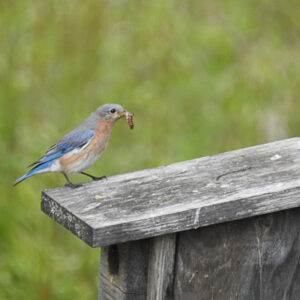
A female Bluebird with food for one of her offspring waiting in a nearby tree at Singing Meadows
A female bluebird with food for one of her offspring waiting in a nearby tree at Singing Meadows.
Tree Swallows have started laying eggs in several nest boxes on six land trust preserves. Unlike the bluebirds, which typically nest twice per season, the swallows will nest only once.
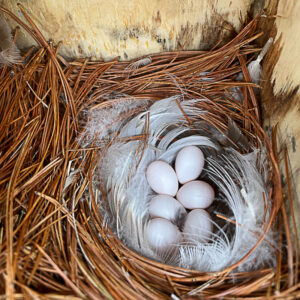
Tree Swallow eggs at Oak Point Farm
Last week, we saw an interesting sequence of bird nesting events at Zak preserve. Bluebirds started building a nest in one of the nest boxes, but didn’t finish it. A Black-capped Chickadee subsequently moved in and built her own unique nest and deposited several eggs in it. Then, a few days later, a bluebird started building a nest on top of the chickadee nest with the eggs! We’ll know later in the week if this nest box changes hands (or wings) yet again.
Despite the reduced number of birds migrating last week, there were still some very interesting sightings. One of the more colorful birds we see at this time of the year is the Baltimore Oriole, which breeds in Maine. We believe they may be nesting on a few of our land trust preserves.
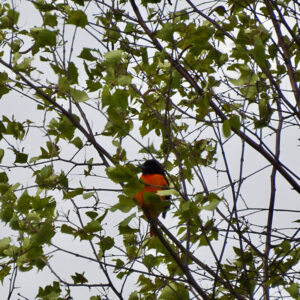
Male Baltimore Oriole at Singing Meadows
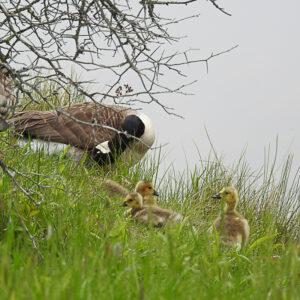
Adult and juvenile Canada Geese at Oak Point Farm
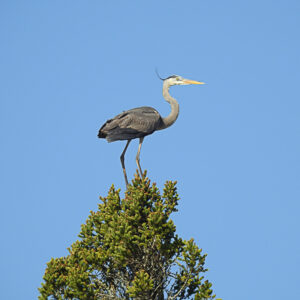
Great Blue Heron perched on top of a tall pine tree at Oak Point Farm
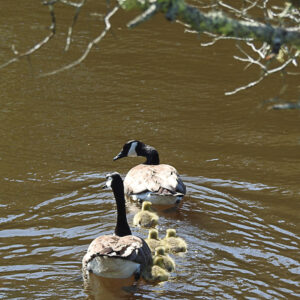
Canada Geese with goslings at Oak Point Farm
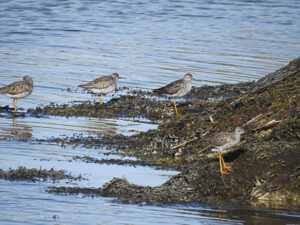
Lesser Yellowlegs at Oak Point Farm
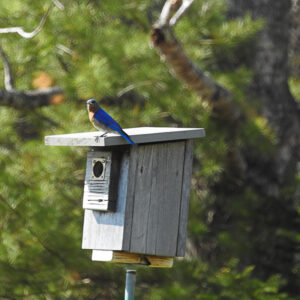
Eastern Bluebird on nest box at Penny Lake
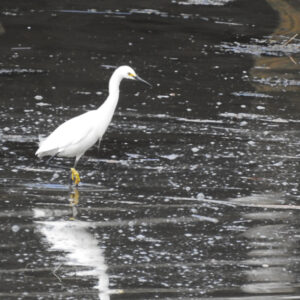
Snowy Egret at Oak PointFarm
We now have bird breeding activity on all six preserves that have nest boxes. Autumn View was late to the game, but now has nest-building going on in two of three nest boxes. Tree Swallows appear to have claimed one nest box while an undetermined bird has started a nest in another. We should know more about the latter in a few more days. We’re expecting the first young bluebirds at Singing Meadows to fledge in about 10 days, on or about 17 May. Until then, we’ll be watching for more bluebird eggs to hatch on several Land Trust preserves in the next several days.
The spring migration continues in fits and starts. BirdCast (birdcast.info), a radar-based method of estimating how many birds migrate each night, has shown varying numbers of birds flying over Lincoln County. Some nights, as many as 200,000 might fly overhead, while other nights there may be as few as 2,000. Of course, not all of these birds will land in Lincoln County by morning, but BirdCast does provide a reasonable idea of the number of migrating birds we might expect to see on any given day. The daily numbers will increase over the next 3 to 4 weeks.
A walk this week at Oak Point Farm resulted in over 35 bird species spotted and heard in less than an hour. Among those were: Belted Kingfisher, Baltimore Oriole, Ovenbird, Northern Parula, Wilson’s Warbler, Pine Siskin, and Black and White Warbler. The usual suspects, such as Song and Chipping Sparrows, Goldfinches, Tree Swallows, Juncos, Eastern Bluebirds, Chickadees, Bluejays, and Cardinals, were also seen in sizeable numbers.
A question was recently asked about why bluebirds were seen pecking at windows on cars and houses at this time of the year. Like many bird species (Cardinals, Tree Swallows, etc.), bluebirds are very territorial during the breeding season. If they see their reflection in a window, they think they’re seeing a rival. Their response is to defend their breeding territory, and they try to drive their “rivals” away. Both males and females of some species will do this. This is not generally harmful to the birds as long as they’re not flying into the windows at high speed. The birds can be deterred from this behavior by placing some self-sticking clear Saran wrap on the outside of the window just above the window sill where they are pecking. That will disrupt their reflections, but will allow light to pass through. Once the breeding season is over, the Saran wrap can be easily removed.
Bluebird breeding activity has ramped up quickly in the past several days on all but one of the six Land Trust preserves with nest boxes. We now have eggs and/or baby Blues at Lobster Cove, Penny Lake, Oak Point, Zak, and Singing Meadows.
Lobster Cove has its first Bluebird eggs (3) of the season in one of two nest boxes. One or two more eggs may have been deposited by the time you read this.
Penny Lake has 4 Bluebird eggs in one of the three nest sites, while one nest box has what appears to be the beginning of a Tree Swallow nest.
Oak Point currently has two nest boxes with at least two Bluebird eggs in each, with more eggs likely to be deposited. Tree Swallows appear to have claimed two nest boxes for breeding purposes.
Zak preserve currently has 4 Bluebird eggs in one nest box, while a second nest box has the beginnings of another nest.
Singing Meadows is leading the pack with Bluebird eggs in two nest boxes (at least 6 so far) and is the first Land Trust preserve of the season to have newly-hatched Bluebirds (4 and 5, respectively) in two nest boxes.
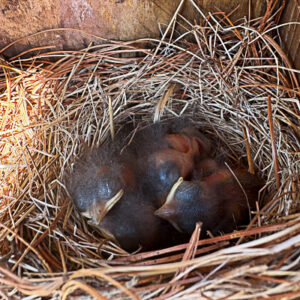
Young Bluebirds at Singing Meadows
The Spring migration is also ramping up quickly. Increased bird song is notable throughout the Boothbay area as thousands of migrating birds settle each morning to rest and refuel for the next night’s journey. Many more Warbler species are being seen & heard every day on Land Trust preserves. Yellow-rump, Pine, Palm, and Black-and-white Warblers are being joined by other species such as Phoebes, Ruby-crowned Kinglets, Hermit Thrushes, and Towhees. White-throated and Chipping Sparrows are already quite numerous and are highly vocal on all Land Trust preserves. Many more returning species will be appearing in the next weeks as the migration heads toward its peak.
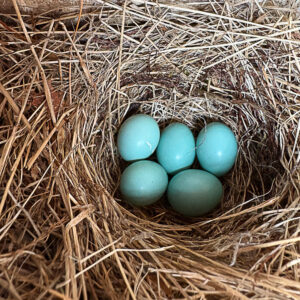
More bluebird eggs at Singing Meadows
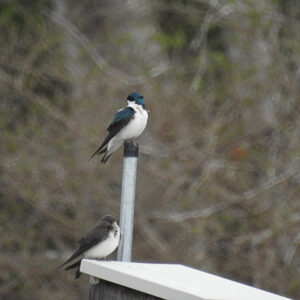
Tree Swallows preparing nest at Oak Point Farm
Other than a few nests built at the other preserves, there has been no additional breeding activity, but that should change soon.
Among the birds we expect to see departing the Midcoast area for their far north breeding territories are several duck species, including Buffleheads, Surf Scoters, Common Eiders, and Long-tailed Ducks. All of these species were seen this past week at Oak Point.
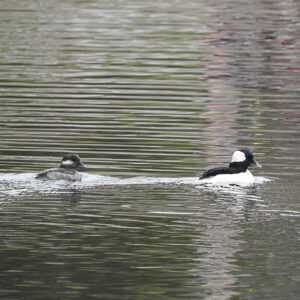
Male and female Buffleheads at Oak Point Farm
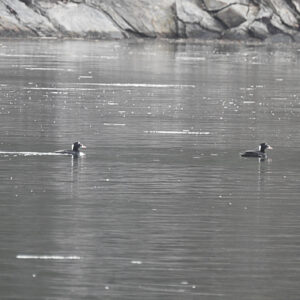
Male Surf Scoters at Oak Point Farm
A few of the birds seen returning to Maine this past week include Pine and Palm Warblers, Chipping and White-throated Sparrows, and Ruby-throated Hummingbirds. Although no hummingbirds have been reported yet in the Boothbay area, they are being seen in adjoining counties, so now is a good time to clean out your nectar feeders and fill them for these “flying gems.”
Last week was a busy time for Bluebirds on five of six Land Trust preserves. Singing Meadows was the busiest of all with five active nest sites. Four of those nest sites now contain eggs (13 so far), and one site has a nest in which we hope to see eggs this week.
Oak Point Farm currently has four active Bluebird nests, but no eggs so far. That is expected to change this week.
Lobster Cove Meadow and Penny Lake each have one active nest site, with more expected soon.
Zak preserve has two active nest sites with a third that we hope will become active this week.
Bird migration numbers are increasing daily. Birdcast.info is a Cornell University website that shows approximately how many birds fly over Lincoln County each night. The day-to-day numbers can vary based on factors such as wind speed and direction, and precipitation, but we’re beginning to see numbers in the 10’s and 100’s of thousands. On the night of April 18th, over one million birds flew over Lincoln County on their way north to breeding grounds! Those numbers will continue to increase significantly in May and June. Among the many species we can expect to see are Phoebes, Blue Grosbeaks, Blue-headed Vireos, and several varieties of sparrows and colorful warblers. Morning is the best time to see and hear these migrating birds on Land Trust preserves and in backyards.
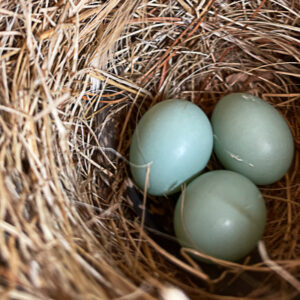
The First Bluebird eggs of the season at Singing Meadows
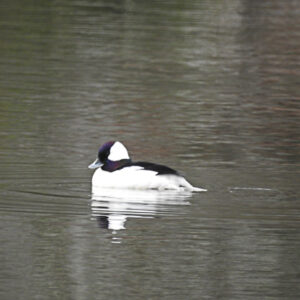
Male Bufflehead at Oak Point
Happy Spring to all! The bird breeding season is officially underway on at least one of our Land Trust preserves. An inspection of nest boxes at Singing Meadows on Saturday revealed the presence of no less than three Eastern Bluebird nests. As of yesterday, no eggs had been deposited in these nests, but that is likely to change in the near term. This indicates that many of our year-round resident Bluebirds are reclaiming nest boxes they used last year. As the migration season warms up, we expect to see Tree Swallows and more Bluebirds claiming nest boxes as well. Nests will likely begin to appear on other Land Trust preserves in the coming days and weeks.
Last year’s warmer-than-usual summer is believed to have caused the loss of a few Bluebird and Tree Swallow nestlings before they could fledge. Heat buildup inside some nest boxes simply became too much for the youngsters to endure. As a result, we’ve modified some nest boxes to reduce or eliminate heat stress. You may see some nest boxes on our preserves with a white roof or a roof with a smaller, square piece of wood on top. These are the modified nest boxes that will hopefully reflect solar heat and/or shade the main roof to keep the interior from excessive heat buildup. If these nest boxes are successful in reducing or eliminating heat stress, we’ll modify more of them in the Fall.
The annual spring bird migration is only just getting started for us in Maine. On your walks through our preserves be on the lookout for some of the many colorful migrant birds working their way north. The migration won’t really peak until May when thousands of birds will return to their traditional breeding grounds in Maine and points north.